
The Real Gap Between Setting Up a Company and Running It Successfully
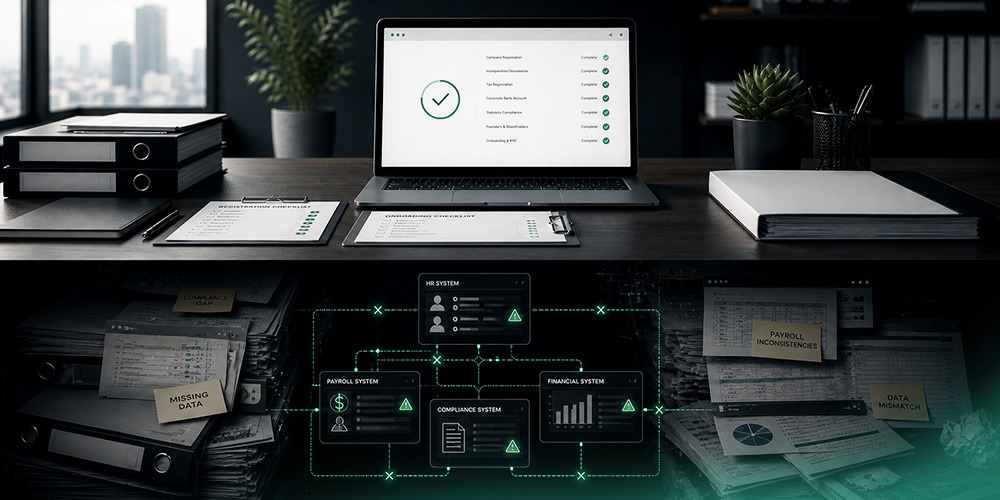
Setting up a company is often seen as the hardest part of expansion.
In reality, it’s the easiest.
Most global companies can complete registration, open accounts, and hire initial teams within a reasonable timeframe. On paper, the business is operational.
But what happens next is where most companies struggle.
Because setting up a company creates presence.
Running it successfully requires structure.
And that gap between setup and execution is where operations begin to fail.
This is a common pattern seen in expanding businesses, especially when growth is prioritised over structure, as explored in Scaling Operations in Sri Lanka: Why Growth Fails Without Governance.
What Does Setting Up a Company in Sri Lanka Actually Include?
Setting up a company establishes the legal and administrative foundation required to operate in a new market.
This typically includes:
- Business registration and legal structure
- Bank account setup
- Initial hiring and onboarding
- Basic compliance requirements
These steps are essential, but they are only the starting point.
They allow a company to begin operations.
They do not ensure those operations will run effectively.
Many companies assume setup is the main milestone, but the real challenge starts after, particularly when operational systems are not aligned across functions, something often overlooked during early expansion phases.
What Does It Take to Run a Company Successfully After Setup?
Running a company successfully goes far beyond setup.
It requires building systems that ensure consistency, control, and scalability across operations.
This includes:
- Structured HR and employee lifecycle management
- Accurate payroll and statutory compliance
- Integrated financial reporting and cost visibility
- Clear operational workflows and approvals
- Alignment between teams, systems, and leadership
Without these elements, operations may function, but they will not scale efficiently.
This is where many organisations start to face challenges around payroll accuracy and compliance, especially in new markets, as discussed in Why Foreign Companies Struggle With Payroll Accuracy in Sri Lanka.
Why Do Companies Struggle After Setting Up a Business?
Why Setting Up a Company Is Not Enough for Long-Term Success
Many companies assume that once the company is registered and teams are in place, operations will naturally stabilise.
They don’t.
Without structured systems, each function begins to operate independently, creating gaps in execution.
How Localised Processes Create Operational Gaps Across Markets
To move quickly, companies often allow each market to build its own processes.
While this helps in the short term, it leads to:
- Inconsistent HR practices
- Misaligned payroll systems
- Different reporting structures
- Fragmented compliance handling
Over time, this creates operational complexity across the organisation.
Why HR, Payroll, and Finance Must Be Integrated in Operations
HR, finance, and compliance are often managed separately.
In reality, they are deeply interconnected.
When these functions are not aligned:
- Payroll data does not match financial reporting
- Compliance gaps go unnoticed
- Workforce costs are not clearly visible
The issue is not execution.
It is lack of integration.
This lack of integration becomes even more visible when companies attempt to manage teams across multiple regions without a unified structure, a challenge further explored in Struggling to Standardise Operations Across Markets.
Why Delaying Operational Structure Leads to Bigger Problems
Most companies only address operational structure after problems appear.
By that time:
- Processes are already inconsistent
- Systems are difficult to align
- Teams are used to working independently
Fixing operations at this stage requires restructuring, not optimisation.
What Happens When There Is No Operational Structure in Place?
The gap between setup and execution does not create immediate failure.
It creates gradual inefficiency.
Over time, this leads to:
- Limited visibility
Leadership cannot clearly track costs, performance, or compliance
- Operational friction
Teams spend more time coordinating than executing
- Compliance exposure
Regulatory requirements are handled inconsistently
- Slower decision-making
Lack of reliable data delays business decisions
These issues compound as the company grows.
Why Businesses in Sri Lanka Need a Strong Operational Structure
Sri Lanka offers strong advantages for global companies:
- Skilled and cost-effective workforce
- Strong capabilities in finance and professional services
- Strategic positioning for global operations
However, many companies entering Sri Lanka focus heavily on setup and hiring, while underestimating operational structure.
This results in:
- Disconnected HR and payroll systems
- Inconsistent financial reporting
- Reduced visibility across operations
Companies that approach Sri Lanka as part of a structured global model tend to perform better, particularly when supported by aligned operational frameworks.
Setup vs Operations: What Is the Real Difference?
The difference between setting up and running a company successfully comes down to one factor.
Structure.
Setup gives you the ability to operate.
Structure determines how well you operate.
Without structure, operations remain reactive.
With structure, operations become controlled, scalable, and predictable.
How to Build Structured Operations After Company Setup
To move from setup to successful execution, companies need to focus on building an integrated operational model.
This includes:
- Defining a Core Operating Framework
Establish how HR, payroll, compliance, and finance should function together - Aligning Systems Across Functions
Ensure all operational data is consistent and connected - StandardisingProcesses Across Markets
Maintain consistency while allowing for local adaptation - Building Visibility for Leadership
Enable clear insights into costs, performance, and compliance - Implementing Structure Early
Avoid retrofitting systems after operations become complex
How an Extended Office Model Supports Business Operations
Bridging the gap between setup and execution requires more than internal effort.
It requires a structured operational approach.
An extended office model enables companies to:
- Integrate HR, payroll, compliance, and finance into one system
- Maintain consistent processes across markets
- Ensure visibility and control at all levels
- Scale operations without fragmentation
This is the approach used by Envoy Ortus to help global companies move beyond setup into structured operations.
Setting up a company is a milestone.
Running it successfully is an ongoing process.
Companies that focus only on setup often struggle with inefficiencies, compliance risks, and lack of visibility.
Those who invest in structure early build operations that scale with control and clarity.
If your company is already set up but operations feel inconsistent, that’s not a temporary issue.
It’s a structural gap.
Envoy Ortus helps global companies move beyond setup by building structured, extended office models that integrate HR, finance, compliance, and operational support into one aligned system.
This gives you:
- Full operational visibility
- Consistent processes across markets
- Reduced compliance risk
- A scalable structure for growth
Speak with Envoy Ortus and assess whether your business is truly structured for success or simply set up to operate.