- Level 6, East Tower, World Trade Center, Colombo 00101
- info@envoyortus.com
- +94 77 799 5533

Employment Law in Sri Lanka: What Foreign Employers Must Get Right
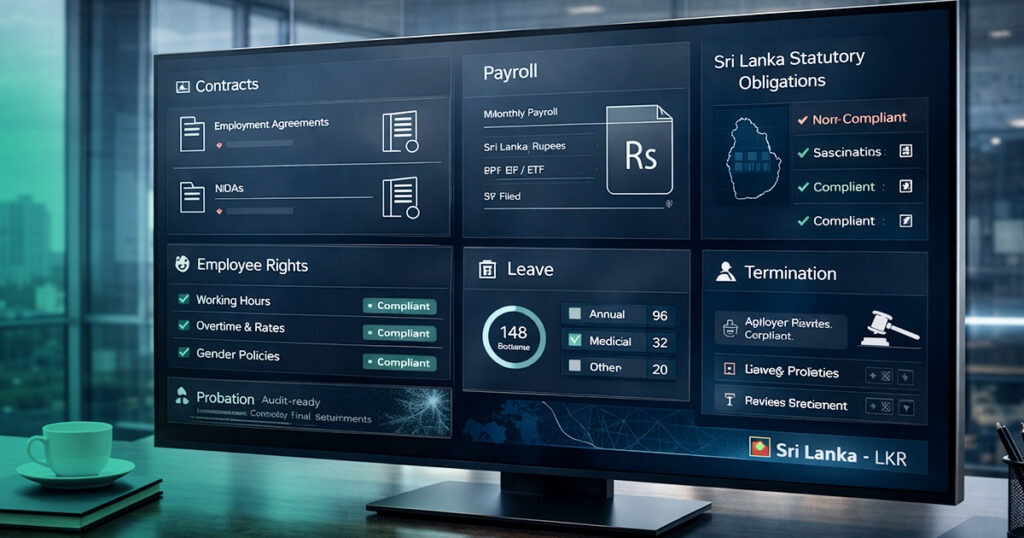
Expanding into Sri Lanka provides access to skilled professionals, competitive operating costs, and strong sector depth across technology, finance, and business services.
However, foreign employers entering the market often underestimate one critical factor: employment law in Sri Lanka.
The regulatory environment is structured, enforceable, and protective of employees. Misalignment with Sri Lankan employment regulations can create financial exposure, operational disruption, and reputational risk. Before building teams locally, foreign companies must clearly understand the employment laws applicable in Sri Lanka and how these laws shape their obligations as employers.
What Employment Laws Apply in Sri Lanka?
Several statutory frameworks govern employment relationships in Sri Lanka.
Core labour regulations in Sri Lanka include:
- The Shop and Office Employees Act
- The Wages Board Ordinance
- The Termination of Employment of Workmen Act
- Employees’ Provident Fund and Employees’ Trust Fund legislation
- Gratuity laws in Sri Lanka
- Occupational safety and workplace compliance requirements
These Sri Lankan employment regulations apply to both local and foreign employers operating within the country.
Foreign companies cannot rely on employment practices from their home jurisdiction. Local labour regulations take precedence for employees based in Sri Lanka. Organisations evaluating market entry models should review Setting Up a Company in Sri Lanka vs Using an Extended Office Model before committing to a structure that may not suit early-stage operations.
How Does Sri Lanka’s Labour Law Affect Foreign Companies?
Sri Lanka’s labour law directly affects foreign companies in several significant ways.
- Statutory Contributions
Employers must register for and contribute to EPF and ETF schemes in accordance with Sri Lankan employment regulations. These contributions are mandatory and closely monitored.
- Termination Restrictions
Termination laws in Sri Lanka are structured and protective. In certain employment categories, approval from the Sri Lanka Labour Department may be required before termination. Employers must follow lawful disciplinary procedures and maintain proper documentation.
- Mandatory Employment Conditions
Working hours, leave entitlements, probation period regulations, and wage protections are clearly defined under labour regulations in Sri Lanka.
Foreign employers unfamiliar with HR compliance in Sri Lanka often assume greater flexibility than the law permits. Understanding employer obligations in Sri Lanka is fundamental to responsible expansion.
Where hiring volumes are expected to increase, compliance must scale alongside recruitment strategy. Structured support, such as Recruitment & Talent Solutions in Sri Lanka ensures that hiring and legal compliance evolve together.
HR Compliance in Sri Lanka: Core Employer Obligations
HR compliance in Sri Lanka extends well beyond issuing an employment contract.
Foreign employers must ensure:
- Written contracts aligned with Sri Lankan employment regulations
- Proper statutory registration
- Accurate payroll calculations and statutory deductions
- Protection of employee rights in Sri Lanka
- Clearly defined disciplinary procedures
- Documentation aligned with labour regulations
Workplace compliance in Sri Lanka requires administrative discipline and effective governance oversight.
Failure to maintain compliance may trigger review by the Sri Lanka Labour Department. Organisations developing their hiring framework may also benefit from reviewing The Hiring Mistakes Foreign Companies Make in Sri Lanka, particularly where workforce design and governance systems are still evolving.
Termination Laws in Sri Lanka
Termination laws in Sri Lanka are frequently misunderstood by foreign employers.
Under the Termination of Employment of Workmen Act, certain dismissals require:
- Justifiable cause
- Documented disciplinary procedures
- Compliance with statutory notice requirements
- In some cases, approval from the Sri Lanka Labour Department
Redundancy, misconduct, and performance-based dismissals must follow established legal processes.
Foreign companies accustomed to at-will employment models must adjust expectations accordingly. Businesses expanding under a managed operational structure often explore Extended Office Solutions in Sri Lanka to ensure HR, finance, and compliance oversight remain integrated.
Probation Period Regulations
Probation period regulations in Sri Lanka must be clearly documented within employment contracts.
While probation enables employers to assess suitability, it does not remove employer obligations under broader Sri Lanka employment regulations.
Improper handling of probation termination may expose employers to legal challenge. Structured documentation and lawful procedure remain essential.
Gratuity Laws in Sri Lanka
Gratuity laws in Sri Lanka require employers to provide lump sum payments to eligible employees who complete a qualifying period of service.
Foreign employers frequently overlook gratuity obligations when modelling workforce costs.
Gratuity liabilities must be incorporated into long-term financial planning. Ignoring gratuity laws in Sri Lanka can create future financial strain that affects operational stability.
Employee Rights in Sri Lanka
Employee rights in Sri Lanka are reinforced through statutory leave entitlements, maternity protections, regulated working hours, and wage safeguards.
Employers must ensure:
- Compliance with regulated working hours
- Overtime payments where applicable
- Leave management aligned with statutory entitlements
- Non-discriminatory workplace practices
Workplace compliance in Sri Lanka includes safeguarding employee rights while maintaining structured operational oversight.
Disciplinary Procedures and Documentation
Disciplinary procedures must follow clear and documented processes.
This includes:
- Written warnings
- Providing the employee with an opportunity to respond
- Investigation records
- Proportionate corrective measures
Failure to implement lawful disciplinary procedures weakens an employer’s position in the event of a dispute.
Foreign companies must align internal HR frameworks with Sri Lankan labour regulations rather than importing informal policies from other jurisdictions.
What Are Employer Obligations in Sri Lanka?
In summary, employer obligations in Sri Lanka include:
- Compliance with employment law in Sri Lanka
- Adherence to statutory contribution requirements
- Observance of termination laws in Sri Lanka
- Alignment with probation period regulations
- Fulfilment of gratuity laws in Sri Lanka
- Protection of employee rights in Sri Lanka
- Proper reporting and registration with the Sri Lanka Labour Department
These obligations apply irrespective of company size or foreign ownership.
Workplace Compliance in Sri Lanka Requires Structure
Foreign employers often focus on recruitment strategy, salary competitiveness, and market entry timing.
However, long-term operational stability depends upon disciplined HR compliance in Sri Lanka and adherence to labour regulations.
Employment law in Sri Lanka is not designed to restrict business. It exists to regulate employment relationships responsibly.
Companies that align early with Sri Lanka employment regulations scale with greater predictability. Those who rely on assumptions typically face corrective costs later.
Understanding employment law in Sri Lanka is not merely a legal requirement. It is a leadership responsibility.
Before expanding operations or hiring locally, foreign companies should ask:
- Are we fully aligned with Sri Lankan labour law?
- Are our employment contracts compliant?
- Are our termination processes defensible?
- Are our statutory contributions accurate?
Ignoring workplace compliance in Sri Lanka does not reduce complexity. It postpones it.
Foreign employers who invest in structured HR compliance frameworks protect both their workforce and their long-term operational stability.
If your organisation is planning to hire or expand in Sri Lanka this year, now is the time to assess whether your employment framework is designed for regulatory clarity, financial control, and scalable growth.
Engage with an experienced operating partner such as Envoy Ortus to review your compliance position before expansion accelerates.
Because correcting employment mistakes after growth is always more expensive than designing the structure correctly from the outset.