
Why Your First 90 Days in a New Market Decide Everything

Why Your First 90 Days in a New Market Decide Everything Expanding into a new market often looks successful from the outside. The company is registered. The first employees are hired. Operations officially begin. From a leadership perspective, this stage creates momentum. The business is visible in a new market, teams are beginning to operate, and expansion plans appear to be moving in the right direction. But this is also where many companies make a critical mistake. They assume setup equals operational readiness. It doesn’t. Because entering a market and operating successfully within it are two very different things. The first 90 days after expansion determine whether operations will become: structured and scalable operationally fragmented difficult to manage as growth increases This period shapes: operational workflows reporting visibility workforce alignment compliance consistency long-term operational control And once operational habits are established incorrectly, fixing them later becomes significantly more difficult and expensive. For companies expanding internationally, especially into growing operational hubs like Sri Lanka, the first 90 days are not simply a transition period. They are the operational foundation for everything that follows. This is why many growing businesses eventually face the same operational challenges discussed in The Real Gap Between Setting Up a Company and Running It Successfully. Why the First 90 Days Matter in Global Expansion Most businesses treat expansion as a setup process. In reality, expansion is an operational integration process. The first three months determine: how teams communicate how reporting structures develop how payroll and compliance are managed how leadership receives visibility across operations how scalable the business becomes over time What many companies fail to realise is that operational complexity does not appear suddenly. It builds gradually. Small inconsistencies begin to form across departments and teams. Different workflows emerge. Reporting structures evolve independently. Manual workarounds become normal operational behaviour. At first, these issues appear manageable. But over time, they create fragmentation across the organisation. This is why the first 90 days are critical. Because businesses either: establish operational structure early or create inefficiencies, they will spend years trying to correct This is also why companies scaling across multiple regions often struggle with operational alignment, a challenge explored further in Struggling to Standardise Operations Across Markets? Here’s What Global Companies Get Wrong. What Companies Should Focus on During the First 90 Days Building Operational Structure Early One of the biggest mistakes companies make during expansion is focusing only on activity. Hiring teams. Launching operations. Delivering output. But activity alone does not create operational stability. Without structure, businesses become heavily dependent on individuals instead of systems. Teams solve problems differently, reporting standards vary, and operational consistency begins to weaken. Businesses entering a new market should establish: clear operational workflows approval structures reporting processes communication channels escalation systems from the very beginning. This creates consistency before complexity increases. Companies that delay operational structure often find themselves rebuilding systems later while simultaneously trying to manage growth. That creates unnecessary operational pressure. Aligning HR, Payroll, and Compliance Systems Many companies treat HR, payroll, and compliance as separate functions during expansion. That creates operational gaps almost immediately. For example: HR onboarding processes may not align with payroll systems Compliance documentation may be inconsistent across teams Workforce reporting may differ between departments Over time, this reduces operational visibility and increases dependency on manual corrections. The issue is not usually poor execution. It is lack of alignment between functions that should operate together. Successful companies integrate these functions early instead of managing them independently. This is especially important for companies expanding into Sri Lanka, where payroll compliance, statutory obligations, and workforce management must remain aligned from the beginning. Without that alignment, operational inefficiencies become embedded into the business very quickly. Many foreign companies underestimate this during expansion, which later contributes to payroll inconsistencies and reporting gaps discussed in Why Foreign Companies Struggle With Payroll Accuracy in Sri Lanka. Creating Visibility for Leadership One of the first things businesses lose during expansion is clarity. Leadership often struggles to clearly see: workforce costs operational performance compliance status reporting consistency This usually happens because systems evolve separately across teams and departments. Different reporting formats emerge. Data becomes inconsistent. Leadership receives fragmented operational information instead of one clear operational view. Without centralised visibility: decision-making slows down reporting becomes unreliable operational risks become harder to identify The first 90 days should focus heavily on building reporting structures that provide leadership with visibility across all operational functions from the start. Because visibility is what allows businesses to maintain control while scaling. Standardising Processes Across Teams During rapid expansion, teams often develop their own ways of operating. At first, this feels efficient because teams can move quickly without waiting for formal operational structures. But over time, businesses begin experiencing: inconsistent approvals disconnected workflows duplicated operational effort varying reporting standards This creates fragmentation across the organisation. And fragmentation increases operational complexity every time the business scales further. Standardisation during the first 90 days helps ensure: consistency across departments operational scalability easier management across markets smoother communication between teams Without standardisation, growth creates operational friction instead of operational efficiency. This becomes especially visible in rapidly growing companies, where scaling without governance creates hidden operational pressure, similar to the issues explored in Scaling Operations in Sri Lanka: Why Growth Fails Without Governance. Building Systems for Scalability, Not Just Survival Most companies entering a new market focus only on immediate functionality. The goal becomes: “Get operations running as quickly as possible.” But systems built purely for speed rarely support long-term growth. Temporary processes become permanent. Manual workarounds become operational habits. Teams adapt to inefficiencies instead of fixing them. Over time, this creates operational strain across the business. The first 90 days should focus on building: scalable operational systems integrated reporting structures sustainable workflows long-term governance processes This reduces the need for restructuring later and creates a much stronger operational foundation for future expansion. Why This Matters for Companies Expanding Into Sri Lanka Sri Lanka continues to grow as a destination for global operational support and extended office functions. Businesses are attracted by: skilled talent availability cost-efficient operational models strong finance and professional service capabilities However, many companies focus heavily on market entry while underestimating operational structure during the early stages. This creates long-term challenges around: operational alignment reporting visibility payroll consistency workforce management Companies that establish structured operations during the first 90 days are significantly more likely
The Real Gap Between Setting Up a Company and Running It Successfully

The Real Gap Between Setting Up a Company and Running It Successfully Setting up a company is often seen as the hardest part of expansion. In reality, it’s the easiest. Most global companies can complete registration, open accounts, and hire initial teams within a reasonable timeframe. On paper, the business is operational. But what happens next is where most companies struggle. Because setting up a company creates presence. Running it successfully requires structure. And that gap between setup and execution is where operations begin to fail. This is a common pattern seen in expanding businesses, especially when growth is prioritised over structure, as explored in Scaling Operations in Sri Lanka: Why Growth Fails Without Governance. What Does Setting Up a Company in Sri Lanka Actually Include? Setting up a company establishes the legal and administrative foundation required to operate in a new market. This typically includes: Business registration and legal structure Bank account setup Initial hiring and onboarding Basic compliance requirements These steps are essential, but they are only the starting point. They allow a company to begin operations. They do not ensure those operations will run effectively. Many companies assume setup is the main milestone, but the real challenge starts after, particularly when operational systems are not aligned across functions, something often overlooked during early expansion phases. What Does It Take to Run a Company Successfully After Setup? Running a company successfully goes far beyond setup. It requires building systems that ensure consistency, control, and scalability across operations. This includes: Structured HR and employee lifecycle management Accurate payroll and statutory compliance Integrated financial reporting and cost visibility Clear operational workflows and approvals Alignment between teams, systems, and leadership Without these elements, operations may function, but they will not scale efficiently. This is where many organisations start to face challenges around payroll accuracy and compliance, especially in new markets, as discussed in Why Foreign Companies Struggle With Payroll Accuracy in Sri Lanka. Why Do Companies Struggle After Setting Up a Business? Why Setting Up a Company Is Not Enough for Long-Term Success Many companies assume that once the company is registered and teams are in place, operations will naturally stabilise. They don’t. Without structured systems, each function begins to operate independently, creating gaps in execution. How Localised Processes Create Operational Gaps Across Markets To move quickly, companies often allow each market to build its own processes. While this helps in the short term, it leads to: Inconsistent HR practices Misaligned payroll systems Different reporting structures Fragmented compliance handling Over time, this creates operational complexity across the organisation. Why HR, Payroll, and Finance Must Be Integrated in Operations HR, finance, and compliance are often managed separately. In reality, they are deeply interconnected. When these functions are not aligned: Payroll data does not match financial reporting Compliance gaps go unnoticed Workforce costs are not clearly visible The issue is not execution. It is lack of integration. This lack of integration becomes even more visible when companies attempt to manage teams across multiple regions without a unified structure, a challenge further explored in Struggling to Standardise Operations Across Markets. Why Delaying Operational Structure Leads to Bigger Problems Most companies only address operational structure after problems appear. By that time: Processes are already inconsistent Systems are difficult to align Teams are used to working independently Fixing operations at this stage requires restructuring, not optimisation. What Happens When There Is No Operational Structure in Place? The gap between setup and execution does not create immediate failure. It creates gradual inefficiency. Over time, this leads to: Limited visibility Leadership cannot clearly track costs, performance, or compliance Operational friction Teams spend more time coordinating than executing Compliance exposure Regulatory requirements are handled inconsistently Slower decision-making Lack of reliable data delays business decisions These issues compound as the company grows. Why Businesses in Sri Lanka Need a Strong Operational Structure Sri Lanka offers strong advantages for global companies: Skilled and cost-effective workforce Strong capabilities in finance and professional services Strategic positioning for global operations However, many companies entering Sri Lanka focus heavily on setup and hiring, while underestimating operational structure. This results in: Disconnected HR and payroll systems Inconsistent financial reporting Reduced visibility across operations Companies that approach Sri Lanka as part of a structured global model tend to perform better, particularly when supported by aligned operational frameworks. Setup vs Operations: What Is the Real Difference? The difference between setting up and running a company successfully comes down to one factor. Structure. Setup gives you the ability to operate. Structure determines how well you operate. Without structure, operations remain reactive. With structure, operations become controlled, scalable, and predictable. How to Build Structured Operations After Company Setup To move from setup to successful execution, companies need to focus on building an integrated operational model. This includes: Defining a Core Operating FrameworkEstablish how HR, payroll, compliance, and finance should function together Aligning Systems Across FunctionsEnsure all operational data is consistent and connected StandardisingProcesses Across Markets Maintain consistency while allowing for local adaptation Building Visibility for LeadershipEnable clear insights into costs, performance, and compliance Implementing Structure EarlyAvoid retrofitting systems after operations become complex How an Extended Office Model Supports Business Operations Bridging the gap between setup and execution requires more than internal effort. It requires a structured operational approach. An extended office model enables companies to: Integrate HR, payroll, compliance, and finance into one system Maintain consistent processes across markets Ensure visibility and control at all levels Scale operations without fragmentation This is the approach used by Envoy Ortus to help global companies move beyond setup into structured operations. Setting up a company is a milestone. Running it successfully is an ongoing process. Companies that focus only on setup often struggle with inefficiencies, compliance risks, and lack of visibility. Those who invest in structure early build operations that scale with control and clarity. If your company is already set up but operations feel inconsistent, that’s not a temporary issue. It’s a structural gap. Envoy Ortus helps global companies move beyond setup by building structured, extended office models that integrate HR, finance, compliance, and operational support into one aligned system. This gives you: Full operational visibility Consistent processes across markets Reduced compliance risk A scalable structure for growth Speak with Envoy
Struggling to Standardise Operations Across Markets? Here’s What Global Companies Get Wrong

Struggling to Standardise Operations Across Markets? Here’s What Global Companies Get Wrong Expanding into multiple markets looks like progress. In reality, it often creates complexity. Most global companies focus on growth, entering new regions, hiring teams, and launching operations. But what they underestimate is what happens behind the scenes. As markets expand, support functions become fragmented. HR processes differ by country. Financial reporting lacks consistency. Compliance requirements are handled in isolation. On the surface, the business is growing. Internally, control is slowly weakening. This is where standardisation becomes critical. Not as a process improvement, but as a foundation for scalable global operations. This pattern is often seen when organisations scale without structured systems, especially during early expansion phases, as explored in Scaling Operations in Sri Lanka: Why Growth Fails Without Governance. What Does “Standardising Support Functions” Actually Mean? Standardising support functions is not about making every market identical. It is about creating consistent systems, processes, and controls across regions, while allowing for local adaptation where necessary. This typically includes: HR processes and employee lifecycle management Payroll systems and statutory compliance Financial reporting and cost tracking Operational workflows and approvals Data visibility across markets The goal is simple.No matter where you operate, your systems should behave consistently. Many companies confuse operational structure with initial setup, which leads to gaps in execution as operations expand across markets. Why Do Global Companies Struggle to Standardise Operations? Growth Happens Faster Than Structure Most companies expand first and structure later. New markets are launched quickly to capture opportunity. Teams are built, operations begin, and local systems are put in place to keep things moving. But these systems are rarely aligned with a central framework. Over time, each market develops its own way of operating, making standardisation more difficult as the business grows. Local Teams Operate in Silos Each market often builds its own support structure: Separate HR processes Different payroll systems Independent financial reporting Local compliance handling While this may work locally, it creates fragmentation globally. Leadership ends up managing multiple versions of the same function, with no single source of truth. This is where many organisations begin to lose operational visibility, particularly as teams grow across regions. Compliance Is Managed Reactively Regulatory requirements vary across markets. To manage this, companies often rely on local solutions rather than building a unified compliance framework. This leads to: Inconsistent compliance standards Gaps in reporting Increased risk across regions Compliance should be integrated into the operating model, not handled as a separate task in each market. Lack of Centralised Visibility One of the biggest challenges is visibility. Without standardised systems, companies struggle to track: Workforce costs across markets Payroll accuracy and consistency Compliance status by region Operational performance Decisions are made based on partial data, not a complete picture. When visibility is limited, leadership cannot effectively manage global operations. Systems Don’t Scale Across Markets What works in one market does not always scale globally. Different tools, processes, and workflows create incompatibility. As expansion continues, integration becomes more complex, slowing down operations and increasing dependency on manual coordination. This is often where companies realise that scaling operations is not just about adding markets, but about aligning systems. The Hidden Impact of Poor Standardisation Fragmented support functions create problems that are not always immediately visible. Key consequences include: Operational InefficiencyTeams spend time aligning processes instead of executing work Compliance RiskInconsistent standards increase exposure to regulatory issues Financial MisalignmentDifferent reporting structures create inaccurate cost visibility Leadership Blind SpotsLack of unified data limits strategic decision-making Over time, these issues reduce the effectiveness of global expansion. What High-Performing Global Companies Do Differently Companies that scale successfully across multiple markets approach standardisation as a core operational strategy. They focus on: Building centralised frameworks for HR, payroll, and compliance Using consistent systems across all regions Aligning financial reporting and workforce cost structures Maintaining local flexibility within a global structure Ensuring real-time visibility across all markets This allows them to expand without losing control. How to Standardise Support Functions Across Markets Define a Core Operating Model Start with a central structure that defines how support functions should operate globally. This includes: HR frameworks Payroll processes Compliance standards Reporting structures Integrate Systems Across Functions Avoid disconnected tools. Ensure HR, finance, and compliance systems are aligned and share consistent data. Build Centralised Visibility Create reporting systems that provide: Workforce cost insights Compliance tracking Operational performance metrics This allows leadership to make informed decisions across all markets. Balance Global Standards with Local Adaptation Standardisation does not mean removing local flexibility. It means maintaining a consistent core while adapting to local regulations and market conditions. Implement Structure Early The earlier the standardisation is built, the easier it is to scale. Retrofitting the structure after expansion is significantly more complex and costly. Why This Matters for Companies Expanding into Sri Lanka Sri Lanka is increasingly used as a strategic location for global operations due to its: Skilled workforce Cost efficiency Strong capabilities in finance and professional services However, companies entering Sri Lanka often integrate it as a standalone operation rather than part of a global system. This creates: Disconnected HR and payroll processes Inconsistent financial reporting Reduced visibility across operations Integrating Sri Lanka into a structured global framework ensures it contributes effectively to overall business performance. Standardisation and the Extended Office Model Standardising support functions across markets requires more than tools. It requires a structured operational model. An extended office model enables companies to: Integrate HR, payroll, compliance, and finance into one system Maintain consistent processes across regions Ensure visibility and control at a global level Scale operations without fragmentation This approach removes the need to manage multiple disconnected systems across markets. Global expansion without standardisation creates complexity. While growth may continue, operational control begins to weaken. Companies that fail to standardise support functions face inefficiencies, compliance risks, and limited visibility. Those that build structured, integrated systems gain control, clarity, and scalable growth across markets. Standardisation is not an operational upgrade.It is
Why Foreign Companies Struggle With Payroll Accuracy in Sri Lanka

Why Foreign Companies Struggle With Payroll Accuracy in Sri Lanka Payroll should be straightforward. For many foreign companies operating in Sri Lanka, it is not. What begins as a simple process, calculating salaries and making payments, quickly becomes complex once statutory requirements, compliance obligations, and local regulations come into play. The result is a pattern seen across many overseas operations: payroll errors, compliance gaps, and growing internal friction. These issues are rarely caused by a lack of effort. A lack of structure causes them. More importantly, payroll problems are often the first visible indicator that deeper operational systems are not properly aligned, particularly when financial control frameworks are not clearly defined from the beginning, as explained in strengthening financial controls before launching operations. What Makes Payroll in Sri Lanka Complex? Payroll in Sri Lanka encompasses more than just salary disbursement. It is tightly linked to statutory compliance, employee benefits, and regulatory reporting. Key components include: EPF (Employees’ Provident Fund) contributions ETF (Employees’ Trust Fund) contributions PAYE tax calculations where applicable Leave and attendance adjustments Employment contract alignment Statutory reporting and documentation Each of these must be calculated accurately and consistently. Even small misalignments can create compliance risks over time. For foreign companies, what appears to be a routine financial process is actually a multi-layered compliance system, something many overlook when focusing primarily on entity setup rather than operational readiness, an issue often seen when businesses prioritise incorporation over structure, as discussed in setting up a company in Sri Lanka. Why Do Foreign Companies Struggle With Payroll Accuracy? Misunderstanding Statutory Requirements Sri Lanka’s payroll system is built around statutory contributions that must be calculated precisely. Common issues include: Incorrect EPF and ETF contribution percentages Delays in statutory payments Misclassification of employees or benefits These are not minor errors. They can lead to penalties, audits, and legal complications. Even small percentage errors, when repeated across multiple payroll cycles, create cumulative exposure that impacts both compliance and financial reporting. Payroll Is Treated as an Administrative Task Many companies treat payroll as a routine back-office activity. In reality, payroll sits at the intersection of: HR Finance Compliance When handled in isolation, errors occur because data is not aligned across departments. Payroll accuracy depends on data consistency across systems, not just calculations, which is why businesses that adopt integrated operational models tend to perform better over time, particularly when evaluating long-term value through structured approaches like those explored in the real ROI of an extended office. Lack of Integrated Systems Foreign companies often rely on: Spreadsheets Disconnected tools Manual calculations This creates: Data inconsistencies Version control issues Increased risk of human error At a small scale, this works. At the growth stage, it breaks. As operations expand, these gaps begin to scale with the business, leading to recurring payroll errors that are harder to trace and correct. Limited Visibility Across Operations As teams grow, payroll becomes more complex. Without proper reporting systems, companies struggle to track: Total workforce costs Statutory liabilities Salary variations and adjustments This leads to inaccurate forecasting and financial misalignment. Leadership may believe costs are under control, while actual payroll obligations tell a different story. Delayed Compliance Adjustments Payroll regulations are not static. Companies that do not stay updated face: Outdated calculations Incorrect deductions Non-compliant reporting Compliance must be managed proactively. When handled reactively, businesses are forced into retroactive corrections, which complicate financial records and increase operational pressure. Real Operational Scenario: Where Payroll Breaks This is how payroll problems typically unfold: A company hires quickly to build a team Payroll is managed through basic tools Statutory contributions are partially understood Minor inconsistencies begin to appear Issues are corrected manually without system improvements At this stage, nothing appears critical. But over time: Errors accumulate Reporting becomes inconsistent Employee concerns increase Compliance risk grows By the time the issue is identified, fixing it requires significant operational restructuring. The Hidden Impact of Payroll Inaccuracy Payroll issues rarely stay within payroll. They affect the entire organisation. Key consequences include: Employee Trust Issues Incorrect or delayed salaries reduce confidence Compliance Risk Errors in statutory contributions can trigger penalties Financial Reporting Gaps Inaccurate payroll data affects budgeting Operational Disruption Time spent fixing errors reduces focus on growth Over time, payroll becomes the point where deeper operational inefficiencies become visible. Why Payroll Accuracy Matters More for Foreign Companies For foreign companies, payroll errors are not just operational. They are strategic risks. Operating in a new market increases: Regulatory exposure Dependency on local systems Risk of reputational impact This makes payroll accuracy a critical part of overall operational control. The Cost of Fixing Payroll Problems Late Many companies delay investing in structured payroll systems. This leads to: Historical payroll corrections Financial reconciliation challenges Employee dissatisfaction Increased administrative workload Fixing payroll late is significantly more complex than building it correctly from the start. How to Improve Payroll Accuracy in Sri Lanka Improving payroll accuracy requires structure, not effort. A structured approach includes: Clear understanding of local regulations Integrated HR and finance systems Standardised payroll processes Continuous compliance monitoring Centralised operational visibility This shifts payroll from a reactive task into a controlled system. Payroll Accuracy and the Extended Office Model Payroll cannot function effectively in isolation. It must be integrated with: HR Compliance Finance Reporting A structured extended office model ensures payroll operates within a controlled system, providing accuracy, compliance, and visibility across the organisation. Why Sri Lanka Remains a Strong Market Sri Lanka offers: A skilled workforce Cost efficiency Strategic global positioning However, these advantages only translate into results when supported by structured operational systems. Payroll accuracy is not just about salary payments. It is about compliance, financial control, and operational stability. Companies that treat payroll as a simple task face recurring issues. Companies that build structured systems gain long-term control and scalability. If you are operating or planning to expand in Sri Lanka, payroll accuracy should not be left to chance. Envoy Ortus enables companies to operate through a structured, extended office model that integrates payroll, HR, compliance, and finance into one controlled system. This ensures: Accurate payroll Compliance confidence Operational visibility Scalable growth Speak with Envoy Ortus to assess whether your payroll systems are built for control or just patched together over time.
The Real Role of HR Support When Building Teams in Sri Lanka

What Foreign Directors Must Understand About Legal Responsibilities in Sri Lanka Most companies expanding into Sri Lanka believe HR support begins with hiring and ends with payroll. That assumption is flawed. HR is not a support function. It is a core operational system that determines whether your overseas team performs, complies, and scales effectively. Without structured HR, companies don’t fail at hiring. They fail at managing what they’ve built. More importantly, HR becomes the difference between a team that simply exists and a team that delivers measurable business outcomes. For many companies, this gap only becomes visible after operations begin, especially when financial control and governance are not properly structured from the start, something explored further in how financial controls impact overseas operations. What Does HR Support Actually Mean in Sri Lanka? In Sri Lanka, HR support is not limited to recruitment or administration. It governs the entire employee lifecycle, tightly connected with compliance, payroll, and operational control. A complete HR structure includes: Employment contracts aligned with Sri Lankan labour law EPF and ETF contribution management Payroll processing with statutory compliance Leave, attendance, and employee record management Disciplinary procedures and termination handling Ongoing compliance monitoring and reporting For foreign companies, this is not just operational. It is legal, financial, and structural. Each of these elements must work together consistently. When even one part is misaligned, it creates ripple effects across payroll accuracy, compliance status, and employee experience. This is why companies that focus only on entity setup often struggle later, as operational structure matters more than incorporation alone, as discussed in setting up a company in Sri Lanka vs building an operational model. Why HR Support Fails in Most Overseas Expansions Most companies don’t lack HR resources. They lack HR structure. HR Is Treated as an Isolated Function HR is often handled separately from finance, compliance, and operations. This creates: Payroll inconsistencies Compliance gaps Lack of reporting alignment HR cannot operate in isolation. It must be integrated into the operating model. When HR is disconnected, leadership loses the ability to track workforce performance against financial and operational outcomes. Compliance Is Underestimated Sri Lanka’s labour framework requires: Accurate statutory contributions (EPF, ETF) Proper documentation Defined termination procedures The mistake companies make is assuming compliance is a one-time setup task. It is not. It is an ongoing operational responsibility. Regulatory accuracy must be maintained continuously, not corrected after issues appear. Reactive compliance is where most businesses start losing control. Payroll Errors Are Seen as Minor Issues They are not. Payroll errors directly impact: Employee trust Legal standing Financial accuracy Even small miscalculations can escalate into: Employee disputes Regulatory scrutiny Operational disruption Over time, repeated inconsistencies create internal friction that slows down productivity and damages organisational credibility. Growth Happens Without HR Systems At small scale, informal processes work. As teams grow, they break. This leads to: Inconsistent policies Missing documentation No performance visibility This is where most overseas teams lose control. Without defined systems, companies move from structured growth into reactive management, where decisions are made based on issues rather than strategy. HR Support vs HR Outsourcing, Why the Difference Matters This is where most companies make the wrong decision. HR outsourcing: Handles tasks (payroll, hiring, admin) Works in silos Focuses on execution Structured HR within an extended office model: Integrates HR with finance, compliance, and operations Aligns reporting with leadership Maintains operational control Builds long-term scalability Outsourcing solves tasks. An operating model solves structure. The difference becomes clearer when comparing traditional approaches with more integrated models, particularly when evaluating long-term value, as explained in the real ROI of an extended office. The Real Risk: Managing Without Visibility The biggest problem is not hiring. It is losing visibility after hiring. Without structured HR systems, companies cannot clearly see: Workforce costs Compliance status Employee performance Operational risks This creates a dangerous gap between: What leadership assumes What is actually happening on the ground Over time, this lack of visibility leads to delayed decisions, inaccurate forecasting, and reduced operational confidence. How Structured HR Support Changes the Outcome When HR is embedded into a structured operating model, it becomes a control mechanism. Key outcomes: Operational ControlClear processes reduce errors and inconsistencies Compliance ConfidenceAll employment and statutory obligations are properly managed Financial AccuracyPayroll and workforce costs align with financial reporting Employee StabilityBetter management leads to higher retention Leadership VisibilityDecision-makers gain real-time insight into team performance and structure Beyond this, structured HR also enables predictability. Businesses can plan growth, forecast costs, and scale teams with confidence instead of reacting to operational issues. Building Teams in Sri Lanka the Right Way If you are entering Sri Lanka, HR should not follow your operations. It should be built into them from day one. A structured approach includes: Legally compliant employment frameworks Integrated payroll and statutory systems Defined HR policies and workflows Clear reporting across HR, finance, and operations Local expertise aligned with global standards This is not outsourcing. This is operational design. Companies that adopt this approach early avoid the costly restructuring phase that typically happens after problems emerge. Why Sri Lanka Works, If Managed Correctly Sri Lanka offers: A skilled, English-speaking workforce Strong capabilities in finance, IT, and professional services Strategic time zone alignment Cost efficiency But these advantages only translate into results when supported by structured HR and operational systems. Without structure, businesses experience delays, inconsistencies, and performance gaps that cancel out the initial cost advantages. HR is not an administrative layer. It is the system that holds your overseas operation together. Companies that treat HR as a support function struggle with compliance, payroll, and employee management. Companies that build HR into their operating model gain control, visibility, and scalable growth. In international expansion, success is not defined by how quickly you enter a market, but by how well your operations are structured once you are there. If you are building a team in Sri Lanka, the question is not just how fast you can hire. It is whether your HR, compliance, and operational systems are built to support that growth. Envoy Ortus enables companies to operate through a structured, extended office model that integrates HR, compliance, and operations into one controlled system.
What Foreign Directors Must Understand About Legal Responsibilities in Sri Lanka

What Foreign Directors Must Understand About Legal Responsibilities in Sri Lanka Sri Lanka continues to attract foreign businesses looking to establish regional operations. The talent base is strong, the cost structure is competitive, and the legal framework is familiar to many international investors. On the surface, setting up and operating a company appears straightforward. In practice, however, foreign directors consistently underestimate one area, their legal responsibilities under Sri Lanka’s Companies Act. This is not a minor oversight. It is one of the most common structural risks seen in foreign-led operations. Businesses often move quickly in the early stages. Still, without proper control systems, those gaps expand as the company grows, a pattern clearly visible in Scaling Operations in Sri Lanka: Why Growth Fails Without Governance. What Are the Foreign Director’s Responsibilities in Sri Lanka? In Sri Lanka, a director is a legally accountable role governed by the Companies Act No. 7 of 2007. Directors are expected to: Act in good faith and in the best interests of the company Exercise reasonable care, skill, and diligence Avoid conflicts of interest Ensure accurate financial reporting and statutory compliance Maintain proper governance and oversight These duties apply regardless of where the director is based. There is no distinction between local and foreign directors when it comes to legal responsibility. Cross-border structures often reduce visibility, which creates risk if not managed properly. This becomes more evident when looking at How to Build and Manage Offshore Teams in Sri Lanka Without Legal Risk. Are Foreign Directors Liable in Sri Lanka? Yes. Foreign directors are fully liable under Sri Lankan law. This includes situations where: The director is not physically present in Sri Lanka Operations are handled by local management Compliance functions are outsourced A common misunderstanding is that delegation reduces liability. It does not. Responsibility remains at the director level, even when execution is handled elsewhere. In many cases, operational gaps appear at the execution stage while accountability remains at the leadership level, a pattern seen in Why Hiring Overseas Fails at Execution, Not Sourcing. Common Compliance Gaps Foreign Directors Overlook The issue is rarely intentional. It is structural. Foreign directors often prioritise speed during market entry, assuming governance can be formalised later. That delay creates risk. Financial visibility is one of the first areas where problems emerge. When reporting is fragmented or delayed, decision-making weakens and exposure increases. This becomes particularly clear in Before You Launch Operations in Sri Lanka, Strengthen Your Financial Controls. Other common gaps include: Over-reliance on local teams for compliance Lack of documented approval processes Informal governance structures Delayed response to regulatory requirements These issues do not create immediate failure. They build pressure over time. Why Delegating Tasks Does Not Remove Director’s Responsibility Delegation is necessary for operations. But it does not transfer accountability. Foreign directors often work with local teams, accountants, or external service providers. These parties support execution, but they do not assume legal responsibility. This creates a false sense of security. Without direct oversight, issues may remain undetected until they escalate into financial or regulatory problems. What the Sri Lanka Companies Act Requires of Directors Under the Companies Act, directors are expected to maintain: Accurate financial records and reporting Proper documentation of decisions Compliance with statutory obligations Clear separation of personal and company interests Beyond this, directors are expected to ensure that systems are in place to prevent risk. This includes defined approval structures, financial control mechanisms, and consistent reporting frameworks. The way a company is structured from the beginning plays a major role here, particularly when comparing Setting Up a Company in Sri Lanka vs Using an Extended Office Model. Failure to meet these expectations can result in financial penalties, legal exposure, and reputational damage. Why Governance Becomes Critical During Growth In the early stages, gaps are often invisible. But as the company grows, complexity increases. Hiring expands, financial activity becomes layered, and regulatory exposure grows. What once felt manageable becomes difficult to control. This challenge is amplified in distributed and cross-border teams, where maintaining control requires stronger systems, something reflected in The Future of Global Teams: Why Hybrid Borders Are the Next Big Shift. Growth without structure leads to instability. How Foreign Directors Can Strengthen Oversight in Sri Lanka To reduce risk and maintain control, foreign directors should focus on: Building centralised financial control systems Defining clear approval and reporting structures Ensuring real-time visibility into operations Aligning local execution with global compliance standards Working with partners who prioritise transparency More importantly, directors must shift from reactive oversight to proactive governance. Sri Lanka offers a strong environment for international business. But success is not determined by entry. It is determined by how operations are structured and governed over time. Foreign directors who underestimate their legal responsibilities often face issues later in the business lifecycle. Those who prioritise governance early build operations that are stable, scalable, and controlled. Strengthen Control Before Risk Becomes Exposure Expanding into Sri Lanka is not just about entering a market. It is about operating with clarity, control, and accountability from day one. Most foreign directors only recognise compliance gaps after they begin to impact operations. By then, correction is no longer simple. At Envoy Ortus, the focus is not just on supporting operations but on building structured, compliant, and fully visible operating environments that allow foreign directors to stay in control, regardless of location. If your business is already operating in Sri Lanka, or planning to enter, the right question is not whether you are compliant. It is whether you have full visibility over your compliance. Speak with Envoy Ortus to assess how your current structure holds up under real operational pressure.
Scaling Operations in Sri Lanka: Why Growth Fails Without Governance

Scaling Operations in Sri Lanka: Why Growth Fails Without Governance Growth is easy. Control is not. Most businesses do not struggle to start. They struggle when growth begins to accelerate. More clients, faster hiring, expanding teams. On the surface, everything looks like progress. Internally, pressure builds quickly. When scaling operations in Sri Lanka, the challenge is not opportunity. It is maintaining control as the business grows. Sri Lanka continues to attract companies looking to expand due to its skilled workforce, cost efficiency, and strategic position between Europe, the Middle East, and Asia. Colombo, in particular, has become a strong base for regional operations and corporate expansion. However, the way a business enters the market determines how stable that growth will be. Many companies move forward without fully understanding the difference between operating through a local entity and an extended structure, such as an extended office model in Sri Lanka, and that early decision directly affects how well operations hold as they scale. When scaling begins to break In the early stages, operational gaps are manageable. A few delays in hiring, unclear reporting lines, or minor financial inconsistencies rarely raise concern. As the business grows, those same gaps begin to expand. Companies building teams in Sri Lanka often prioritise speed. However, without the right structure behind hiring, compliance, and reporting, pressure builds quickly. This becomes evident when organisations attempt to build and manage offshore teams in Sri Lanka without legal risk while still lacking alignment across operations. Common patterns begin to appear: Hiring decisions move faster than approval structures Financial tracking becomes inconsistent across teams Compliance is addressed only after issues arise At this point, what appears to be a hiring issue is often a structural one, reflecting the same patterns seen in hiring mistakes foreign companies make in Sri Lanka. What scaling Operation in Sri Lanla actually requires Scaling is not about adding people. It is about maintaining consistency as complexity increases. That requires: Clear decision-making authority Defined approval processes Financial discipline across departments Alignment between hiring, operations, and compliance Without these, growth introduces confusion instead of efficiency. Financial control is where issues become visible One of the first signs of weak structure appears in finance. Costs begin to increase, but visibility does not keep pace. Teams operate with different assumptions, and reporting becomes inconsistent. This is why structured financial systems play a critical role in scaling operations, particularly when managing distributed teams, as seen in accounting and finance solutions for offshore and extended teams in Sri Lanka. Without clear financial oversight, small gaps quickly develop into larger operational problems. Compliance must be built early, not later A common mistake is treating compliance as a later-stage requirement. In practice, it must be built into the system from the beginning. Understanding employment law in Sri Lanka is not only a legal necessity. It ensures that hiring, payroll, and operational processes remain aligned as the business grows. Delays in this area do not prevent growth immediately. They increase risk over time. Maintaining visibility as operations scale As operations expand, maintaining visibility becomes more difficult. Leadership begins to lose clarity on: Team performance Decision-making processes Financial movement across departments At this stage, the business may still be growing, but control is already weakening. Organisations that maintain stability rely on integrated systems and structured workflows. This shift is increasingly visible in environments shaped by tech-enabled BPO operations in Sri Lanka, where reporting and execution are connected in real time. Why structure matters more than speed Many businesses focus on scaling quickly. Fewer focus on scaling correctly. The difference lies in sequence. Before expanding, companies need: Reporting structures that define responsibility Approval workflows that guide decisions Systems that align finance, HR, and operations This is why operating through models like extended offices and offshore teams provides a stronger foundation, ensuring that structure is embedded into the way the business operates. Common mistakes in expansion Most failures in business expansion in Sri Lanka follow a similar pattern: Hiring before defining systems Managing operations remotely without a local structure Treating compliance as a secondary step Expanding faster than internal processes can support These issues do not stop growth immediately. They weaken it over time. Scaling without losing control Sri Lanka offers a strong platform for companies looking to expand operations and build teams. However, growth alone is not enough. The businesses that succeed are those that maintain control as they scale. Structure is what makes that possible. If your business is planning to scale or expand into Sri Lanka, the priority should not be speed. It should be structured. Understanding whether to operate through a local entity or an extended office model in Sri Lanka is one of the most important decisions you will make. Work with an experienced operating partner like Envoy Ortus to design a structure that supports compliance, financial control, and long-term scalability. Build with clarity. Scale with control.
Employment Law in Sri Lanka: What Foreign Employers Must Get Right
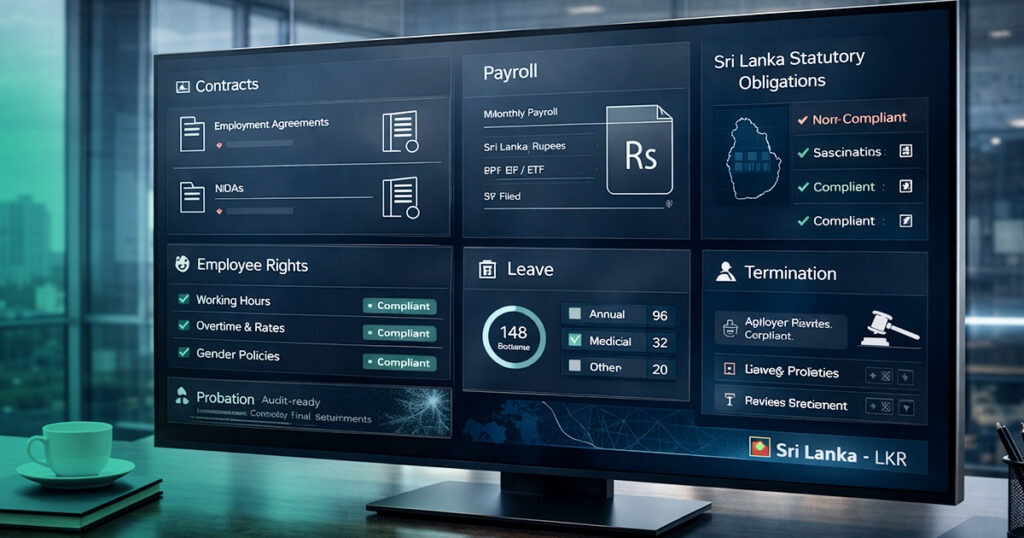
Employment Law in Sri Lanka: What Foreign Employers Must Get Right Expanding into Sri Lanka provides access to skilled professionals, competitive operating costs, and strong sector depth across technology, finance, and business services. However, foreign employers entering the market often underestimate one critical factor: employment law in Sri Lanka. The regulatory environment is structured, enforceable, and protective of employees. Misalignment with Sri Lankan employment regulations can create financial exposure, operational disruption, and reputational risk. Before building teams locally, foreign companies must clearly understand the employment laws applicable in Sri Lanka and how these laws shape their obligations as employers. What Employment Laws Apply in Sri Lanka? Several statutory frameworks govern employment relationships in Sri Lanka. Core labour regulations in Sri Lanka include: The Shop and Office Employees Act The Wages Board Ordinance The Termination of Employment of Workmen Act Employees’ Provident Fund and Employees’ Trust Fund legislation Gratuity laws in Sri Lanka Occupational safety and workplace compliance requirements These Sri Lankan employment regulations apply to both local and foreign employers operating within the country. Foreign companies cannot rely on employment practices from their home jurisdiction. Local labour regulations take precedence for employees based in Sri Lanka. Organisations evaluating market entry models should review Setting Up a Company in Sri Lanka vs Using an Extended Office Model before committing to a structure that may not suit early-stage operations. How Does Sri Lanka’s Labour Law Affect Foreign Companies? Sri Lanka’s labour law directly affects foreign companies in several significant ways. Statutory Contributions Employers must register for and contribute to EPF and ETF schemes in accordance with Sri Lankan employment regulations. These contributions are mandatory and closely monitored. Termination Restrictions Termination laws in Sri Lanka are structured and protective. In certain employment categories, approval from the Sri Lanka Labour Department may be required before termination. Employers must follow lawful disciplinary procedures and maintain proper documentation. Mandatory Employment Conditions Working hours, leave entitlements, probation period regulations, and wage protections are clearly defined under labour regulations in Sri Lanka. Foreign employers unfamiliar with HR compliance in Sri Lanka often assume greater flexibility than the law permits. Understanding employer obligations in Sri Lanka is fundamental to responsible expansion. Where hiring volumes are expected to increase, compliance must scale alongside recruitment strategy. Structured support, such as Recruitment & Talent Solutions in Sri Lanka ensures that hiring and legal compliance evolve together. HR Compliance in Sri Lanka: Core Employer Obligations HR compliance in Sri Lanka extends well beyond issuing an employment contract. Foreign employers must ensure: Written contracts aligned with Sri Lankan employment regulations Proper statutory registration Accurate payroll calculations and statutory deductions Protection of employee rights in Sri Lanka Clearly defined disciplinary procedures Documentation aligned with labour regulations Workplace compliance in Sri Lanka requires administrative discipline and effective governance oversight. Failure to maintain compliance may trigger review by the Sri Lanka Labour Department. Organisations developing their hiring framework may also benefit from reviewing The Hiring Mistakes Foreign Companies Make in Sri Lanka, particularly where workforce design and governance systems are still evolving. Termination Laws in Sri Lanka Termination laws in Sri Lanka are frequently misunderstood by foreign employers. Under the Termination of Employment of Workmen Act, certain dismissals require: Justifiable cause Documented disciplinary procedures Compliance with statutory notice requirements In some cases, approval from the Sri Lanka Labour Department Redundancy, misconduct, and performance-based dismissals must follow established legal processes. Foreign companies accustomed to at-will employment models must adjust expectations accordingly. Businesses expanding under a managed operational structure often explore Extended Office Solutions in Sri Lanka to ensure HR, finance, and compliance oversight remain integrated. Probation Period Regulations Probation period regulations in Sri Lanka must be clearly documented within employment contracts. While probation enables employers to assess suitability, it does not remove employer obligations under broader Sri Lanka employment regulations. Improper handling of probation termination may expose employers to legal challenge. Structured documentation and lawful procedure remain essential. Gratuity Laws in Sri Lanka Gratuity laws in Sri Lanka require employers to provide lump sum payments to eligible employees who complete a qualifying period of service. Foreign employers frequently overlook gratuity obligations when modelling workforce costs. Gratuity liabilities must be incorporated into long-term financial planning. Ignoring gratuity laws in Sri Lanka can create future financial strain that affects operational stability. Employee Rights in Sri Lanka Employee rights in Sri Lanka are reinforced through statutory leave entitlements, maternity protections, regulated working hours, and wage safeguards. Employers must ensure: Compliance with regulated working hours Overtime payments where applicable Leave management aligned with statutory entitlements Non-discriminatory workplace practices Workplace compliance in Sri Lanka includes safeguarding employee rights while maintaining structured operational oversight. Disciplinary Procedures and Documentation Disciplinary procedures must follow clear and documented processes. This includes: Written warnings Providing the employee with an opportunity to respond Investigation records Proportionate corrective measures Failure to implement lawful disciplinary procedures weakens an employer’s position in the event of a dispute. Foreign companies must align internal HR frameworks with Sri Lankan labour regulations rather than importing informal policies from other jurisdictions. What Are Employer Obligations in Sri Lanka? In summary, employer obligations in Sri Lanka include: Compliance with employment law in Sri Lanka Adherence to statutory contribution requirements Observance of termination laws in Sri Lanka Alignment with probation period regulations Fulfilment of gratuity laws in Sri Lanka Protection of employee rights in Sri Lanka Proper reporting and registration with the Sri Lanka Labour Department These obligations apply irrespective of company size or foreign ownership. Workplace Compliance in Sri Lanka Requires Structure Foreign employers often focus on recruitment strategy, salary competitiveness, and market entry timing. However, long-term operational stability depends upon disciplined HR compliance in Sri Lanka and adherence to labour regulations. Employment law in Sri Lanka is not designed to restrict business. It exists to regulate employment relationships responsibly. Companies that align early with Sri Lanka employment regulations scale with greater predictability. Those who rely on assumptions typically face corrective costs later. Understanding employment
The Hiring Mistakes Foreign Companies Make in Sri Lanka

The Hiring Mistakes Foreign Companies Make in Sri Lanka Hiring in Sri Lanka is not difficult. Poor structure is what creates long-term risk. Many foreign organisations entering the Sri Lankan market assume that employment practices operate in the same way as their domestic environment. While recruitment processes may feel familiar, the regulatory framework, statutory obligations, and governance expectations in Sri Lanka require deliberate alignment. If you plan to hire employees in Sri Lanka, getting the structure right from the outset prevents compliance exposure, payroll errors, and operational instability later. Can a Foreign Company Hire Employees in Sri Lanka Legally? Yes. A foreign company can hire employees in Sri Lanka. The critical issue is not whether hiring is possible, but how it is structured. The employment model you choose determines statutory responsibility, payroll compliance, reporting obligations, and long-term flexibility. Recruitment alone does not complete the process. A compliant employment relationship requires properly drafted employment contracts, statutory registration, tax alignment, and governance oversight. Many organisations evaluating their options find it helpful to understand the structural differences between registering a local entity and using an alternative model, as outlined in our article on Setting Up a Company in Sri Lanka vs Using an Extended Office Model. Employment Law in Sri Lanka, What Foreign Employers Must Understand Employment law in Sri Lanka is defined and enforceable. It governs employment contracts, probation periods, termination requirements, gratuity, and statutory employer contributions. Foreign employers frequently underestimate EPF and ETF compliance requirements, termination protections under labour regulations in Sri Lanka, and the importance of properly documented disciplinary procedures. Employment law applies regardless of where the parent company is based. Compliance gaps may not surface immediately, but they introduce financial and reputational consequences over time. For organisations seeking practical guidance on aligning hiring with legal safeguards, our guide on building and managing teams in Sri Lanka without legal risk provides additional clarity. Why Hiring Employees in Sri Lanka Without Structure Creates Risk Hiring must be treated as an operating function, not a vacancy-driven activity. Sustainable workforce development requires structured onboarding, defined reporting lines, clear performance management systems, and workforce planning aligned with projected growth. Organisations that rush to build a team in Sri Lanka without operational planning often experience higher attrition during expansion. As discussed in our review of recruitment and talent acquisition trends, hiring quality increasingly depends on process discipline rather than speed alone. Payroll and Statutory Compliance Requirements in Sri Lanka Payroll integrity is fundamental when hiring in Sri Lanka. Sri Lanka requires accurate statutory contributions, including EPF and ETF compliance, correct tax deductions, and timely reporting. Payroll compliance in Sri Lanka is not optional, and remote management without local alignment increases regulatory exposure. Compliance extends beyond employment contracts. It includes statutory contributions, employer obligations, tax reporting requirements, and monthly payroll documentation accuracy. When organisations hire employees in Sri Lanka without integrated payroll systems, risk accumulates quietly. Workforce Planning in Sri Lanka, Avoiding Overhiring and Instability The Sri Lankan talent market remains competitive, particularly across technology, finance, and corporate services. Some foreign employers accelerate hiring without assessing role clarity, organisational structure, utilisation planning, and governance capacity. Scaling headcount without structure increases operational inefficiency. For organisations preparing for growth, our perspective on Scaling Operations in Sri Lanka, Why Growth Fails Without Governance, explores how expansion must be supported by oversight frameworks rather than reactive hiring decisions. What Is the Best Hiring Structure for Foreign Companies in Sri Lanka? Many foreign organisations assume they must immediately register a company in Sri Lanka to hire locally. In some cases, establishing a legal entity is appropriate. In others, it introduces administrative complexity before operational maturity justifies it. The employment structure in Sri Lanka should reflect business scale, risk appetite, long-term strategic intent, and compliance capacity. Premature structural decisions reduce flexibility and increase fixed obligations that may not align with early-stage growth. Legal Requirements to Hire Employees in Sri Lanka To hire employees in Sri Lanka legally, foreign companies must ensure: Compliant employment contracts Proper statutory registration and contributions Accurate payroll and tax reporting HR policies aligned with labour regulations Lawful termination and disciplinary procedures These requirements are manageable when addressed systematically and early. Building a Compliant and Scalable Workforce in Sri Lanka Sri Lanka offers access to skilled professionals across IT, finance, engineering, and business services. However, the Sri Lankan employment market rewards disciplined execution. Organisations that design structured hiring frameworks scale more predictably. Those that rely on informal processes often face avoidable compliance exposure and operational disruption as they grow. When companies hire employees in Sri Lanka with clear governance alignment, integrated payroll compliance, and structured workforce planning, they create a stable foundation for expansion. The most significant hiring risk foreign companies face in Sri Lanka is not talent scarcity. It is structural oversight. Hiring without legal clarity, payroll integration, and governance alignment may appear efficient initially. Over time, it introduces compliance exposure and operational inefficiency that becomes increasingly difficult to correct. Planning to hire in Sri Lanka? Make sure your employment structure is compliant before your first offer is signed. Speak with Envoy Ortus to build a hiring model that protects your business, supports payroll accuracy, and gives your expansion the control it needs from day one.
How to Build and Manage Offshore Teams in Sri Lanka Without Legal Risk

How to Build and Manage Offshore Teams in Sri Lanka Without Legal Risk Hiring offshore is easy. Staying compliant is where most companies get exposed. Sri Lanka has become a preferred destination for global companies looking to build offshore teams. Talent quality is strong, labour costs are competitive, and time zones work well with Europe, the Middle East, and the Asia Pacific markets. In our previous analysis on Extended Offices & Offshore Teams, we explained why extended offices are increasingly chosen over traditional outsourcing. However, growth advantages do not insulate companies from legal risk unless compliance is embedded into operations. Is It Legal to Hire Offshore Teams in Sri Lanka? Yes, but only when structured correctly. Foreign companies can hire offshore teams in Sri Lanka through different operating models. What matters is execution, not just intent. Hiring without a compliant legal structure, employment contracts, and statutory alignment can create legal exposure even if the team performs well. Sri Lankan employment law applies to all workers operating within the country, irrespective of where the parent company is located. For companies exploring expansion options, understanding the compliance differences between setting up a company in Sri Lanka versus an extended office model is essential. If you want clarity on the pros and cons of those two approaches, see Setting Up a Company in Sri Lanka vs Using an Extended Office Model. Common Compliance Risks in Offshore Team Setup Companies often create legal risk by focusing on speed rather than structure. Employment Misclassification Hiring workers without compliant employment agreements or misclassifying them as independent contractors creates disputes and statutory penalties. Incomplete Statutory Compliance Payroll obligations such as EPF, ETF, PAYE, and statutory reporting must align with Sri Lankan regulations. Gaps here often go unnoticed until audits occur. Fragmented HR Processes When separate vendors handle recruitment, payroll, and compliance, accountability becomes unclear. A structured recruitment process improves onboarding speed and quality, as we explain in How to Fix Hiring Delays with Recruitment Process Outsourcing. Lack of Governance Visibility Without defined risk oversight, leadership cannot see workforce risk until it manifests as audit findings or disputes. These are not operational mistakes — they are structural compliance failures. What Legal and HR Compliance Is Required in Sri Lanka? To manage offshore teams without risk, compliance must operate across multiple layers. Employment Law Compliance Contracts, role definitions, termination clauses, and labour law alignment are mandatory. HR Policy Compliance Policies on leave, working hours, disciplinary processes, and workplace conduct must follow Sri Lankan requirements and be consistently enforced. Payroll and Statutory Obligations Payroll must be processed accurately, including statutory contributions and tax deductions. Ongoing Regulatory Alignment Compliance is not a one-time checklist. Labour laws and reporting requirements change — HR and legal functions need routine updates. These requirements apply whether your offshore team is 10 strong or 100 strong. Managing Remote Teams in Sri Lanka Requires More Than Hiring Managing offshore teams is not just about recruitment. It is about operating a compliant workforce within a controlled system. Companies that succeed build compliance into daily operations through: Centralised HR and payroll management Integrated statutory reporting Risk governance frameworks Leadership visibility into compliance KPIs When compliance is fragmented, risk silently accumulates. A good read that highlights how technology and operating discipline are reshaping global HR operations is The Tech-Enabled Side of Sri Lanka’s BPO Industry – A Look Inside Envoy Ortus’ Operations. How an Extended Office Model Reduces Legal Risk An extended office model allows companies to build offshore teams in Sri Lanka while maintaining legal and operational alignment. Under this structure: Employees are hired under compliant local employment frameworks HR, payroll and statutory obligations are centrally managed Compliance monitoring is continuous, not reactive Leadership receives structured reporting and governance visibility This approach minimises risk by aligning control and compliance under one accountable framework, unlike fragmented outsourcing. Envoy Ortus supports this model through structured extended office solutions in Sri Lanka, enabling companies to build dedicated offshore teams while maintaining full operational control and compliance oversight. Offshore teams in Sri Lanka offer significant advantages, but only when built on a compliant foundation. Legal and HR compliance should not be treated as administrative overhead. It is an operating requirement that protects continuity, reputation, and long-term growth. Companies that embed compliance from day one avoid costly corrections later. Those who delay often find legal risk far more expensive to fix than to prevent. If you want to strengthen your offshore compliance strategy even more, explore Recruitment & Talent Acquisition Trends for emerging workforce dynamics that impact remote and offshore hiring. Build with structure. Scale with certainty. If you are planning to establish offshore teams in Sri Lanka, do not treat compliance as an afterthought. Structural risk compounds over time. Speak with Envoy Ortus to evaluate your offshore operating model before exposure becomes expensive. Our extended office framework is designed to protect governance, ensure statutory compliance, and give leadership full operational visibility from day one. Schedule a confidential consultation to assess your offshore readiness.